![Therapist applying 40 Hz device to patient's back]](https://sakralchimes.com/wp-content/uploads/2026/06/Therapist-applying-40-Hz-device-to-patients-back.jpeg)
40 Hz vibration therapy is a targeted treatment that delivers mechanical oscillations at exactly 40 cycles per second to stimulate gamma brainwave activity, activate mechanoreceptors, and produce measurable cognitive and physical benefits. The clinical term for this approach is vibroacoustic therapy, though whole-body vibration (WBV) platforms and localized vibration devices also operate at this frequency. Research from 2026 confirms that 40 Hz stimulation reduces amyloid protein buildup in neurodegenerative models, modulates pain through nerve signal pathways, and improves balance and bone density in older adults. Sakralchimes has built its entire therapeutic model around this frequency, combining it with sound therapy and crystal healing for a complete wellness approach.
How does 40 hz vibration therapy work?
The core mechanism behind 40 Hz vibration therapy is gamma wave entrainment. Your brain naturally produces gamma waves at around 40 Hz during states of focused attention and memory consolidation. When external vibrations at this frequency reach your nervous system, the brain synchronizes its own electrical activity to match. This process is called neural entrainment, and it is the reason 40 Hz stimulation shows promise in cognitive research.
The second mechanism is mechanotransduction. Vibrations at 40 Hz activate specialized sensory receptors in your skin and muscles, particularly Pacinian corpuscles and Aβ nerve fibers. These receptors send signals up the spinal cord that compete with and suppress pain signals, a process explained by gate control theory. Pain relief occurs primarily through this nerve signal modulation, not through hormonal changes or systemic inflammation reduction. That distinction matters because it explains why effects are often felt within minutes of a session.
The third mechanism involves protein clearance in the brain. Mouse models show reduced amyloid and tau protein accumulation following 40 Hz sensory stimulation. These proteins are associated with Alzheimer’s disease progression. Human studies indicate improved neural connectivity and functional balance in elderly participants, suggesting the animal findings may translate to clinical populations.
Device quality determines whether any of this actually works. Controlled oscillation targets mechanosensitive ion channels, and chaotic or imprecise vibrations miss this target entirely. A cheap consumer massager vibrating at random frequencies will not replicate the effects seen in clinical trials.
Pro Tip: If you are evaluating a vibroacoustic device, ask the manufacturer for frequency accuracy specifications. Therapeutic devices should deliver 40 Hz within a tolerance of plus or minus 1 Hz to maintain clinical relevance.
How does 40 hz therapy compare to other sound therapies?
40 Hz vibroacoustic therapy, whole-body vibration platforms, and binaural beats all target the nervous system, but they do so through different pathways and with different evidence bases.
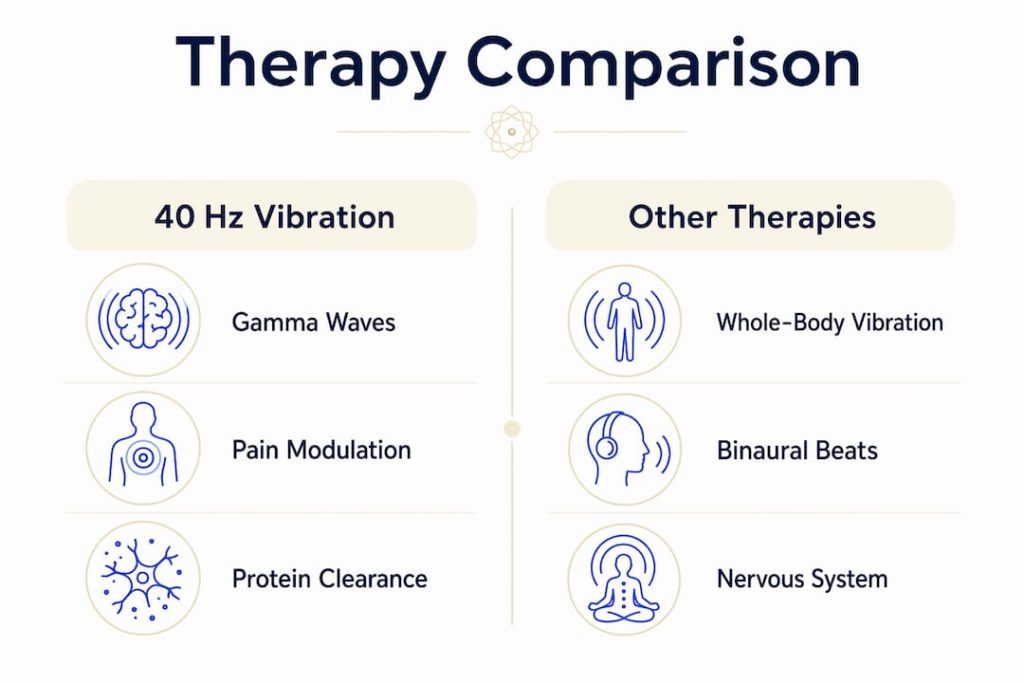
Comparison of Common Vibration and Sound Therapies
| Therapy Type | Primary Target | Session Length | Evidence Strength | Best Use Case |
|---|---|---|---|---|
| 40 Hz Vibroacoustic Therapy | Cognitive function, pain relief | 20–45 minutes | Moderate to strong | Neurological health, chronic pain |
| Whole-Body Vibration (WBV) | Bone density, muscle strength | 10–20 minutes | Strong for physical outcomes | Rehabilitation, osteoporosis |
| Binaural Beats | Brainwave entrainment | 20–60 minutes | Emerging | Relaxation, focus, sleep |
| Traditional Sound Therapy | Emotional regulation | 30–60 minutes | Limited clinical data | Stress, mood support |
Key differences to understand before choosing a method:
- 40 Hz vibroacoustic therapy delivers vibration through a surface or device in direct contact with the body, producing both mechanical and auditory stimulation simultaneously.
- WBV platforms like those used in physical therapy clinics apply vibration to the entire body through a standing or seated platform, with strong evidence for bone density and balance improvements.
- Binaural beats work through headphones only, delivering slightly different frequencies to each ear to create a perceived third frequency. They require no physical contact and have the weakest clinical evidence of the three.
For individuals managing fibromyalgia, post-surgical pain, or early cognitive decline, 40 Hz vibroacoustic therapy offers the most direct mechanism. WBV is the stronger choice for musculoskeletal rehabilitation and fall prevention in older adults.
What are the best session protocols for 40 hz therapy?
Practical application of 40 Hz vibration therapy follows clear protocols based on the condition being treated. Getting the protocol right matters more than most people realize.
- Acute pain management: Use daily sessions of 20–30 minutes. Target the specific muscle group or body region involved. Apply the vibration device for 60–120 seconds per area, then move to adjacent regions. Daily use resets the nervous system’s pain threshold more effectively than sporadic sessions.
- Chronic pain and neuromuscular retraining: Shift to three to five sessions per week rather than daily. Regular session consistency is more important than session intensity for lasting benefits. One-time use produces only transient relief. Commit to at least four weeks before evaluating results.
- Cognitive support and neurological health: Use whole-body or chair-based vibroacoustic platforms for 30–45 minutes per session, three to four times per week. Pair sessions with quiet focus or light meditation to support gamma entrainment.
- Athletic recovery: Apply localized vibration to worked muscle groups immediately post-exercise. Keep sessions to 15–20 minutes. This reduces delayed onset muscle soreness and supports faster neuromuscular recovery.
- Bone density support in older adults: Use a WBV platform at 40 Hz for 20–30 minutes, three times per week. Femur bone mineral density improvements have been documented in postmenopausal women following regular WBV sessions at this frequency.
One common mistake is applying maximum amplitude from the first session. Start at low amplitude and increase gradually over two to three weeks. Therapeutic delivery often scans frequencies slightly around 40 Hz to prevent sensory numbness and maintain receptor responsiveness. A good device or practitioner will account for this automatically.
Pro Tip: Place the vibration device on larger muscle groups like the quadriceps or back for a deep relaxation effect. Stimulation near the head or chest produces a noticeably different and more intense experience. Start with the legs if you are new to the therapy.
What does the research say about 40 hz therapy benefits?
The evidence base for 40 Hz vibration therapy covers four distinct health domains: cognitive function, pain management, physical performance, and body composition.
“40 Hz is the most studied single frequency for brain gamma rhythms and muscle resonance, making it the most clinically relevant target for both neurological and musculoskeletal applications.” — Effects of Mechano-Sonic Vibration Therapy
Research Findings by Health Domain
| Health Domain | Key Finding | Population |
|---|---|---|
| Cognitive function | Improved neural connectivity and functional balance | Elderly adults |
| Pain relief | Analgesic effect via nerve signal modulation | Post-surgical and chronic pain patients |
| Bone density | Significant femur bone mineral density improvements | Postmenopausal women |
| Body composition | Decreased BMI and waist circumference | Rehabilitation patients |
| Neurodegeneration | Reduced amyloid and tau protein accumulation | Mouse models, early human data |
The cognitive findings are the most compelling for anyone exploring this therapy for mental wellness. The alignment with brain gamma waves gives 40 Hz stimulation a biological rationale that most alternative therapies lack. That said, clinical translation still needs more optimization, particularly for Alzheimer’s disease applications in humans.
Pain management results are consistent and well-documented. The gate control mechanism means that 40 Hz vibration physically competes with pain signals at the spinal cord level. This is why patients with fibromyalgia and post-surgical pain report relief within a single session, even if lasting change requires weeks of consistent use.
The body composition finding deserves context. WBV at 40 Hz produces statistically significant decreases in BMI and waist circumference, but it does not significantly change lean mass or visceral fat. This means it supports weight management as an adjunct to exercise and diet, not as a replacement.
Key takeaways
40 Hz vibration therapy works because it targets gamma brainwave entrainment, mechanoreceptor-driven pain modulation, and bone density simultaneously, making it one of the most mechanistically grounded tools in sound frequency therapy.
| Point | Details |
| Frequency precision matters | Devices must deliver 40 Hz within tight tolerance; imprecise vibration misses the therapeutic target. |
| Pain relief is nerve-based | Analgesic effects come from nerve signal modulation via gate control, not hormonal changes. |
| Consistency beats intensity | Daily or weekly sessions over weeks produce lasting benefits; sporadic use yields only short-term relief. |
| Cognitive benefits are real | Gamma entrainment and amyloid clearance in research models support use for neurological health. |
| Multimodal use is best | 40 Hz therapy works best alongside other recovery or wellness practices, not as a standalone solution. |
Why i think most people are using this therapy wrong
Most people who try 40 Hz vibration therapy treat it like a massage chair. They use it once, feel good, and then wonder why the results do not last. That is the wrong frame entirely.
What I have observed, both in research and in practice, is that this therapy functions more like physical training than like a passive treatment. The nervous system adapts to repeated stimulation. One session opens a window. Consistent sessions rebuild the architecture. The difference between someone who gets lasting pain relief and someone who does not is almost always session regularity, not device quality or session length.
The second mistake I see is ignoring amplitude. People crank the intensity up immediately because they assume more vibration means more benefit. Sensory receptors adapt and go numb under sustained high-amplitude input. Starting low and increasing gradually keeps the receptors responsive and the therapy effective over time.
The third thing worth saying plainly: 40 Hz therapy is a tool, not a cure. Experts recommend using it as part of a multimodal recovery approach rather than a standalone solution. Pair it with movement, sleep, and nutrition. That is when the results become genuinely impressive.
— Adrian
Explore sound frequency healing with Sakralchimes
If 40 Hz vibration therapy has your attention, the next step is finding complementary tools that reinforce those same neurological and emotional benefits between sessions.
Sakralchimes specializes in vibroacoustic therapy and healing solfeggio frequencies, offering a curated approach to sound frequency therapy that pairs naturally with 40 Hz protocols. Their products address both physical discomfort and mental wellness through sound, making them a practical complement to any vibration therapy routine. Whether you are managing anxiety, fibromyalgia, or simply want to deepen your relaxation practice, Sakralchimes provides well-researched tools designed for real outcomes. Visit Sakralchimes to explore their full range of sound healing and vibroacoustic therapy offerings.
FAQ
What is 40 hz vibration therapy used for?
40 Hz vibration therapy is used for cognitive support, chronic pain relief, bone density improvement, and neurological health. Clinical research supports its use in elderly populations, post-surgical recovery, and early neurodegenerative conditions.
How long does a 40 hz vibration therapy session last?
Sessions typically last 20–45 minutes, with targeted muscle stimulation applied for 60–120 seconds per area. Daily sessions are recommended for acute pain, while chronic conditions benefit from three to five sessions per week.
Is 40 hz vibration therapy the same as sound therapy?
They overlap but are not identical. 40 Hz vibroacoustic therapy delivers mechanical vibration through direct body contact and often includes auditory components, while traditional sound therapy relies primarily on auditory stimulation without physical vibration.
Does 40 hz vibration therapy reduce pain?
Yes. Pain relief occurs through nerve signal modulation via gate control theory, where Pacinian corpuscles and Aβ fibers suppress pain signals at the spinal cord level. This effect is not hormonal and can be felt within a single session.
How is 40 hz therapy different from whole-body vibration?
Whole-body vibration platforms deliver vibration through a standing or seated surface across the entire body, while 40 Hz vibroacoustic therapy can be applied locally or systemically through specialized devices. WBV has stronger evidence for bone density; 40 Hz vibroacoustic therapy has stronger evidence for cognitive and pain outcomes.